
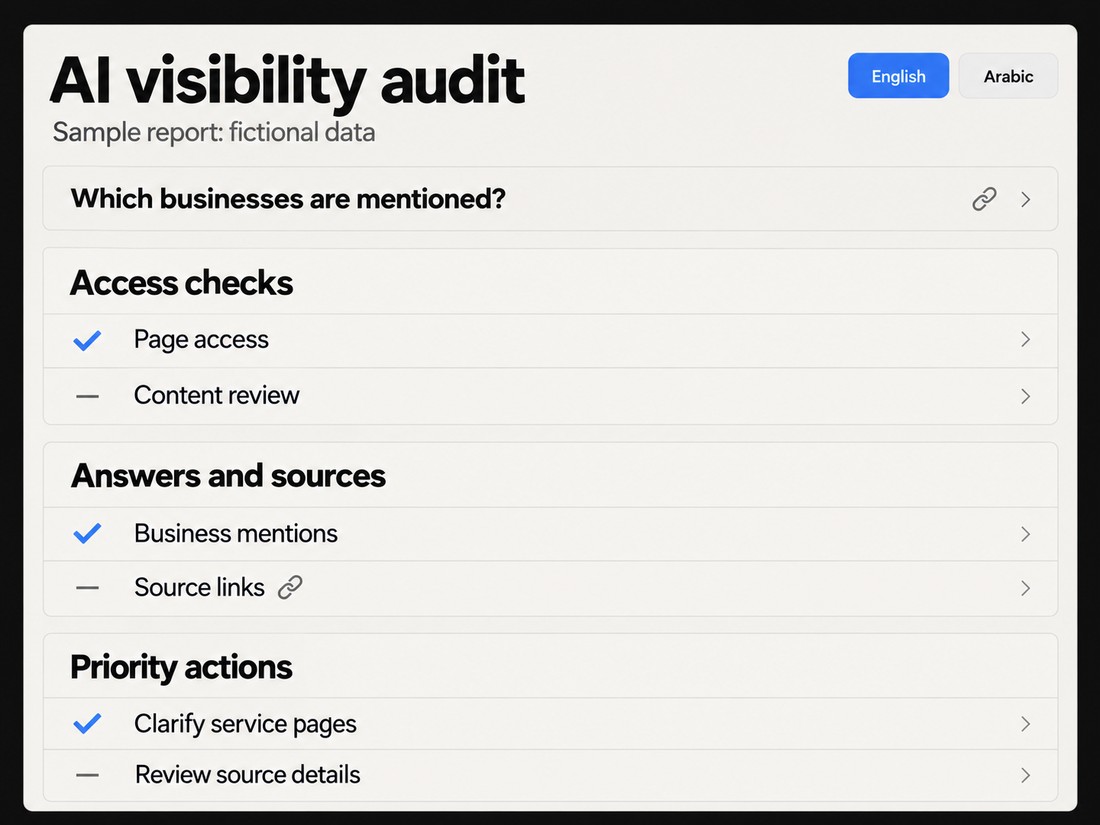
An AI visibility audit checks what relevant questions produce, whether your business is mentioned, which pages are linked and whether the facts are correct. Use a defined question set across the platforms your buyers use. Record the conditions and repeat the checks. A single screenshot cannot establish your overall visibility.
The short version
- Keep discovery questions separate from questions that already name your brand.
- Record mentions, citations, factual errors and visits as different findings.
- Finish with page-level tasks, not just a score.
What should the audit help you decide?
The useful outcome is knowing what to improve first. A technical access problem, an unclear offer and an incorrect external address require different work.
Define the business and the audience before opening an AI tool. A clinic with one Dubai branch, a UAE online store and a regional enterprise vendor should not use the same questions.
Also define the decision. Are you investigating initial discovery, a buyer's comparison, product availability or incorrect company facts? Put each into a separate group so the report stays meaningful.
Which questions should I test?
Ask sales and customer support which questions repeatedly come before an enquiry or purchase. Add relevant search queries where you have them. Use language customers use, rather than marketing terms they would never type.
The table below contains hypothetical starting questions. Adapt the service, place and requirement to the actual business. These are research prompts, not observations about which companies an AI tool currently recommends.
| Question group | Hypothetical prompt | What it investigates |
|---|---|---|
| Local discovery | Which clinics in Jumeirah offer dermatology consultations? | Service and location fit |
| Provider fit | Which agency can improve enquiry tracking for a Dubai clinic? | A specific commercial need |
| Product discovery | Where can I buy soy wax with delivery in the UAE? | Product and seller visibility |
| Comparison | What should I compare when choosing a UAE inventory software provider? | Decision criteria and supporting sources |
| Planning | What should a UAE brand include in an AI visibility project brief? | Informational source coverage |
| Branded accuracy | What services does [business] provide, and where is it based? | Accuracy after the name is supplied |
Include a branded accuracy check, such as “Where is [business] located and what does it offer?” Keep it separate from discovery. Supplying your name makes it easier for the tool to talk about the company and cannot prove unprompted discovery.
Why do I get a different answer every time I ask?
Record the exact wording, platform, date, visible model or mode, language, location stated in the question and whether web search was used. Start fresh conversations where possible.
An API test and a consumer website test may not produce the same experience. If you use a monitoring product, ask how it obtains answers and which settings it controls.
Do not quietly change the question to get a more flattering answer. If you explore a follow-up, save it as a separate observation. Keep cases where the platform did not provide a shortlist or did not show sources.
What should I write down from each answer?
Record whether the business is named and the context in which it appears. Then record any source link to your own site, plus relevant links to other sites.
Check important facts against your approved business information. Look for incorrect locations, outdated hours, services you do not provide and unsupported claims.
Open visible source links. An answer can cite a page that does not support the exact statement beside it. That is a reason to review the evidence, rather than simply counting the link.
If an answer includes a competitor, record the competitor and source. The next question is what information the source supplies that your own pages lack.
What does an AI visibility score actually mean?
A count can be useful if its denominator is clear. “Mentioned in six of our twelve saved discovery checks” describes that set of observations. It does not mean that half of all customers will see your company.
Keep platform-specific results separate before any combined reporting. The question set, languages and repeat frequency affect the result.
Include factual accuracy and source relevance alongside counts. More mentions are not automatically better if the answer describes the wrong service or sends buyers to the wrong branch.
What should I check on my own website?
Inspect the important public pages for access, indexation, clear service information and useful internal links. Review identifiable AI referral visits and conversion events in your analytics.
Microsoft's AI Performance documentation describes citation reporting for supported experiences. Google's AI features guidance explains how its features sit within Search Console's overall Web reporting. Use each source within its documented limits.
A visit with no identifiable referrer should remain unassigned unless you have additional evidence. A self-reported enquiry source is useful, but it should not be presented as exact attribution.
What do I fix first?
Give each issue a specific destination, action, owner and reason. For example: update the delivery page because two current policies conflict; clarify the clinic's available treatments because the service page is vague; investigate search access because a priority page cannot be retrieved.
Separate confirmed problems from possible explanations. If you cannot prove why a competitor appears, write that uncertainty down. Then choose a small, useful change you can evaluate.
AdGrow's free AI visibility audit is a starting review, not a promise to test every possible question. Agree the scope before comparing it with a larger ongoing monitoring programme. Our AI visibility services explain how page improvements follow the review.
If you would rather not run this test yourself, our free AI visibility audit runs it on your business and sends you the raw responses, the questions used and the dates. Request the free audit, or read how we work on AI visibility.
Frequently asked questions
How often should I check AI visibility?
Use a repeatable cycle that suits the project, such as a monthly review with targeted checks after important changes. Consistency matters more than repeatedly checking until the preferred answer appears.
Is an AI visibility score an official ranking?
No. It is a metric defined by the question set and testing method. Ask which platforms, prompts, languages and observations the score includes.
What should a free audit contain?
A clearly defined starting review, observed findings and a short priority list. Confirm which platforms and pages are included rather than assuming a free audit covers the whole site.
Sources and further checks
Platform guidance checked on 12 October 2026. Practical recommendations and hypothetical examples are AdGrow’s editorial guidance, not platform guarantees.