


AdGrow

Book a call

Jewellery and watch marketing in Dubai and the UAE

Where contribution per sale, not ROAS, sets the ceiling.

AdGrow runs paid acquisition for jewellery and watch brands in Dubai and across the Gulf: gold and diamond retailers, bridal specialists, demi-fine labels and watch dealers.

High average order value changes which number should govern the account. A blanket ROAS target borrowed from a fashion or beauty playbook will run a jewellery account far too conservatively to grow, because it ignores the one figure that actually sets your ceiling: the contribution you keep on a single sale.

Gold, diamond, bridal, watches High-AOV account economics Senior-led account teams

Brands we work with

  • VMP Consult logo
  • EliteCare Medical Center logo
  • Sarab logo
  • Muslim Lifestyle Store logo
  • Euphoria Perfumes logo
  • alqamees logo
  • ProAlign Smile Shop logo
  • Resin Art Hub logo
  • mas organic logo
  • Expert Leaders Medical Center logo
  • Al Waha Bird Control logo
  • Platinum Medical Center logo
  • Genové Dermatologics logo
  • YesPasta logo
  • Luxury Mansion logo

The anchor number

AED 478,539.
One quarter, and why the mix matters more.

A quarter on a UAE store we manage, with 51.6% of it from returning customers. In a high-value category the composition of that revenue determines what you can afford to bid.

On a UAE store we manage, one quarter produced AED 478,539 in sales with 51.6% coming from returning customers. For a jewellery brand the instructive part is the relationship between those two figures.

High-value categories do not behave like high-frequency ones. The orders are large and infrequent, which means a small number of transactions determines the quarter and an average ROAS figure across them conceals enormous variance. One bridal sale can outweigh thirty demi-fine orders, and they have completely different margins.

So the governing number is not ROAS at all. It is contribution per sale: what you actually keep after cost of goods, payment fees, insured shipping and returns. Once you know that figure for each of your product tiers, the maximum you can profitably pay to acquire a customer follows arithmetically, and it is almost always a larger number than a blanket ROAS target permits.

Why gold-weight pricing breaks fixed ROAS targets specifically. If a meaningful share of your range is priced off the gold rate, your margin percentage moves with a commodity you do not control. The same necklace sold in two different months at two different gold prices produces two different contributions, and a fixed ROAS target treats them as identical.

Brands that price off weight need a contribution target that recalculates as the rate moves, with the making charge and design premium separated out, because that portion is where your actual margin lives and it does not move with the commodity.

The method

How we run a
jewellery and watch account.

Six decisions. The first changes what the account is measured on, and the rest follow from it.

  • Target contribution per sale, by tier. We work out what you keep on a sale in each of your price tiers after cost of goods, payment fees, insured shipping and returns, then set an acquisition ceiling per tier. A demi-fine order and a bridal commission get different targets because they are different businesses, and averaging them means systematically underbidding on the one worth most to you.
  • Separate the commodity from the craft in your pricing. On gold-weight pricing the metal is a pass-through and the making charge and design premium are your margin. Reporting them together means your margin appears to swing with the gold rate when in reality the part you control has been stable. Separating them is what lets you hold a sensible target through a volatile quarter.
  • Count the sale that closes offline. A large share of jewellery and watch purchases in this market begin online and complete in a showroom or over WhatsApp, because people want to see a stone and try a setting. If your reporting only credits on-site checkout, your campaigns look two or three times worse than they are. We instrument appointment bookings and WhatsApp-initiated sales and attribute them back.
  • Carry the trust load in the creative. Nobody spends five figures with a brand they are unsure about. Certification, stone grading, hallmarking, insured and tracked delivery, the returns window and the physical showroom all belong in the ads and on the landing pages rather than buried in a policy page. At this order value, reassurance is conversion rate.
  • Plan for a long bridal window and a short gifting one. Bridal consideration runs for months with multiple people involved, so it needs sustained presence and a nurture sequence rather than a single conversion push. Gifting peaks around Eid, anniversaries and the festival window and converts quickly. Those two patterns need separate campaigns and separate budgets.
  • Decide deliberately whether you are selling beyond the UAE. Dubai's position means a jewellery or watch brand here can reach buyers across the Gulf and well beyond it, and the economics of doing so are genuinely attractive at high order values because shipping is a small fraction of the basket. It also brings obligations that catch brands out: insured and tracked logistics, customs documentation, duties the customer was not expecting at the door, and a returns path that works across a border. We would rather build this on purpose with the operational side agreed than discover it through an expensive dispute.

AdGrow in numbers

AED 8M+Combined ad spend managed
5.8xAverage ROAS across accounts
25+Brands and clinics
7+ yearsRunning paid ads

What we build

The parts of a
jewellery account.

Tiered contribution targets

An acquisition ceiling calculated per price tier, recalculated as the gold rate moves, with the making charge and design premium separated from the metal pass-through.

Offline and WhatsApp attribution

Showroom appointments and WhatsApp-initiated sales tracked and attributed back to the campaign that caused them, so high-value sales that close in person are not invisible to the account.

Trust-forward landing pages

Certification, grading, hallmarking, insured delivery, the returns window and the showroom presented prominently, because at this order value those details are the conversion mechanism.

Bridal nurture programme

Sustained presence and a sequence built for a months-long decision involving more than one person, kept separate from the fast-converting gifting campaigns.

Product and detail photography

Our shoot team produces macro stone and finish work plus on-body scale references, because at this price the buyer is examining the piece and generic catalogue imagery does not survive that scrutiny.

High-intent search coverage

Search campaigns on specific settings, carats, stones, metals and watch references, where a small volume of extremely well-qualified demand sits at a cost that a contribution-based target can comfortably absorb.

Cross-border selling, built deliberately

If you are shipping outside the UAE, the insured logistics, customs documentation, duty expectations and cross-border returns path agreed up front, so the margin on a high-value international order survives contact with the first dispute.

The arithmetic

Why your account
is probably underbidding.

Here is the calculation most jewellery brands have not run, and it usually changes what they are willing to spend within an afternoon.

Take one tier of your range. Work out the average order value in it, subtract the cost of goods, subtract payment processing, subtract insured shipping, and subtract an allowance for returns at your actual rate. What remains is your contribution per sale. Decide what share of that you are prepared to spend on acquiring the sale, and you have a cost-per-acquisition ceiling. Divide the order value by that ceiling and you have the ROAS target that tier can run at.

Do it across three or four tiers and the result is consistently surprising: the high-value tiers can profitably run at a ROAS that looks alarmingly low next to a fashion benchmark, while the entry tier needs a much higher one. A brand running a single blanket target across all of them is simultaneously overbidding on its cheapest products and underbidding on its most profitable ones, which is the worst of both arrangements.

The second thing the calculation exposes is how much the offline close matters. If a third of your sales complete in the showroom and your reporting does not credit them, every target you set from that reporting is roughly fifty percent too strict. Fixing the attribution usually unlocks more spending room than any change to the campaigns themselves, and it costs nothing in media.

A third consequence is about patience. Because the orders are large and infrequent, a jewellery account needs a longer assessment period before its numbers mean anything. A fortnight in which three bridal enquiries happened to convert will flatter a campaign that is mediocre, and a fortnight in which none did will condemn one that is working. We judge these accounts on rolling quarters rather than weeks, and we tell clients at the outset that the weekly report is for spotting faults, not for making decisions about budget.

Where this goes wrong in practice. Raising the ceiling on a tier whose landing page has not been built to carry the trust argument just buys expensive traffic that does not convert. Fix the page, get the offline attribution working, then raise the bid. In that order it is reliable; in any other order it looks like the contribution model was wrong.

Results

What the managed
accounts show.

UAE e-commerce accounts we manage. These are portfolio figures; jewellery brands sit within it.

Shopify analytics showing a quarter of sales on a UAE store
A managed UAE store over one quarter: AED 478,539 in sales, with 51.6% from returning customers.

UAE store · High-value order mix

AED 478,539 in a quarter, and the mix inside it.

A UAE store we manage over a single quarter. We show it on this page for the composition rather than the total: just over half of the revenue came from customers who had bought before.

In a high-value category that proportion is what makes a contribution-based target safe to run. If returning customers reliably produce half your revenue, your acquisition spend is buying considerably more than the first transaction it is currently charged against.

  • Returning customers behind over half of quarterly revenue
  • Targets set per price tier rather than one blanket figure
  • Contribution calculated after goods, fees, insured shipping and returns
AED 478,539 Sales in the quarter51.6% of it from returning customers
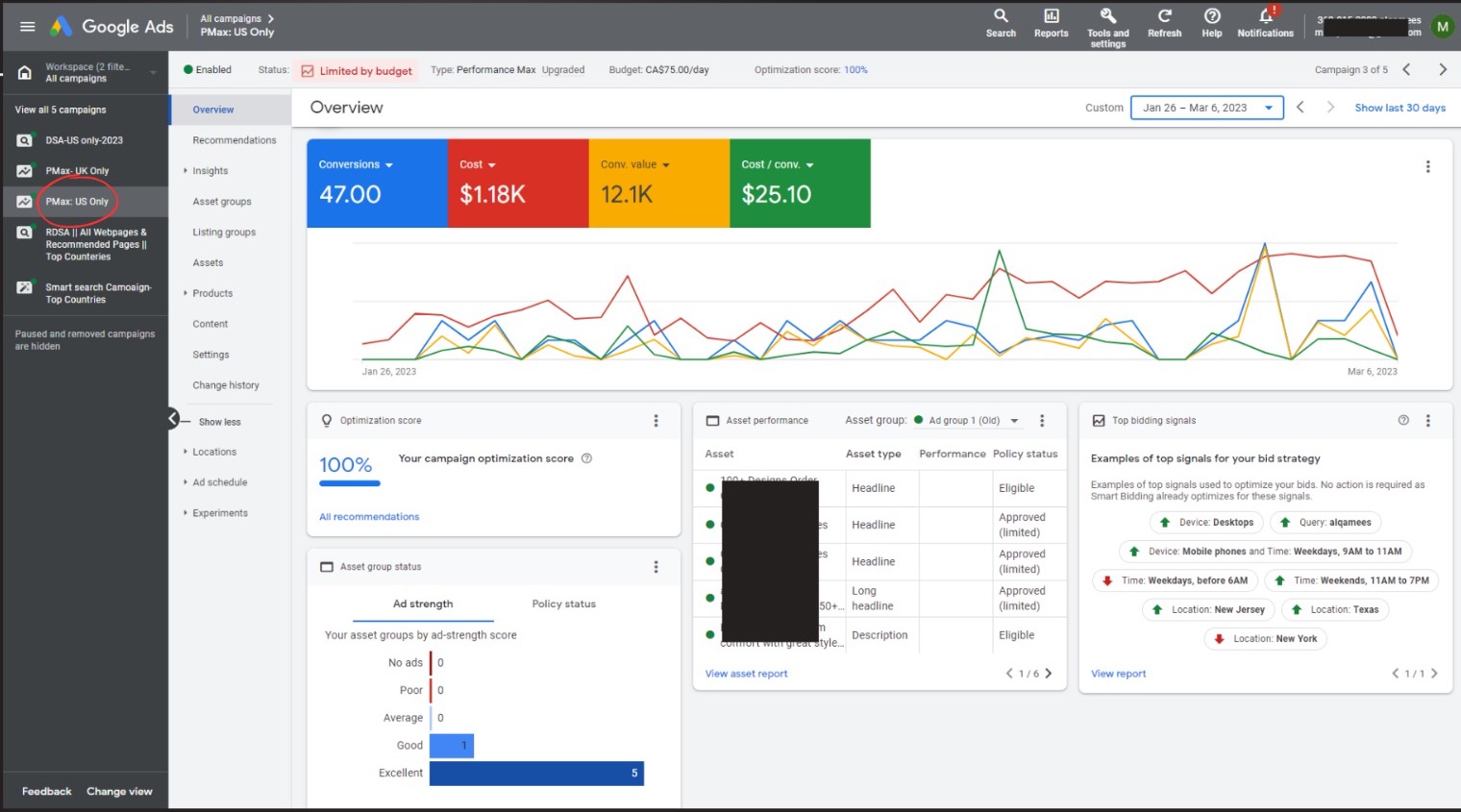
Google Ads Performance Max reporting on a UAE account with international delivery
Performance Max on a UAE account that ships internationally as well as locally.

UAE account · International delivery

High-intent search, where a contribution target pays for itself.

Specific searches for settings, carats, stones, metals and watch references carry very small volumes and extremely high intent. Judged against a blanket ROAS target these terms often look too expensive to bid on, so most accounts do not.

Judged against contribution per sale on the tier they lead to, they are usually among the most profitable traffic available to a jewellery brand. This is the clearest practical consequence of changing which number governs the account.

  • Coverage on specific setting, stone, metal and reference searches
  • Bids set from tier contribution rather than a blanket multiple
  • Feed built so high-value variants are represented accurately
AED 8M+ Combined ad spend managedAcross 25+ brands and clinics

Portfolio figures from accounts we manage, shown with their windows.

How we work with jewellery brands

The ceiling calculated,
then the spend.

What you get

  • An acquisition ceiling calculated per price tier, not one blanket target
  • Showroom and WhatsApp sales attributed back to the campaigns that caused them
  • Making charge and design premium separated from the metal pass-through
  • Bridal and gifting run as separate campaigns with separate budgets
  • You retain the ad account, the photography and the customer records

What you won't get

  • A single ROAS target applied across demi-fine and bridal alike
  • Reporting that ignores the sales completing in your showroom
  • Bids raised before the landing page carries the trust argument
  • High-intent search dismissed as too expensive on the wrong measure

Questions

What jewellery and watch
brands ask us.

The question is the wrong way round. Work out your contribution per sale in each price tier after cost of goods, payment fees, insured shipping and returns, decide what share of it you will spend on acquisition, and the ROAS target follows arithmetically. It will be a different number for demi-fine and for bridal, and a blanket target across both guarantees you underbid on the profitable end.

Because it ignores that one bridal sale can outweigh thirty demi-fine orders at completely different margins. A single target across all tiers means overbidding on your cheapest products and underbidding on your most profitable ones at the same time. The high-value tiers can profitably run at a multiple that looks alarming next to a fashion benchmark.

It means your margin percentage moves with a commodity you do not control, so a fixed ROAS target is measuring the wrong thing week to week. Separate the metal pass-through from the making charge and design premium, because that second part is your actual margin and it stays stable while the rate moves. Then set the target against contribution rather than revenue.

Yes, and it is probably working much better than your reporting shows. If a third of sales complete in person and your attribution only credits on-site checkout, every target derived from that reporting is roughly fifty percent too strict. We instrument appointment bookings and WhatsApp-initiated sales and attribute them back, which usually unlocks more spending room than any campaign change.

Trust and detail. Certification, stone grading, hallmarking, insured and tracked delivery, the returns window and the existence of a physical showroom belong in the ads and on the landing pages rather than in a policy page nobody opens. At five figures, reassurance is the conversion mechanism.

No. Bridal is a months-long decision usually involving more than one person, so it needs sustained presence and a nurture sequence. Gifting peaks sharply around Eid, anniversaries and the festival window and converts in a session. Run together, the fast-converting gifting demand will absorb the budget and the bridal pipeline quietly empties.

Usually yes, and this is where changing the governing number pays off most visibly. Specific setting, carat, stone and watch-reference searches carry tiny volumes and very high intent. Against a blanket ROAS target they look unaffordable; against contribution per sale on the tier they lead to they are often the most profitable traffic in the account.

We run the contribution calculation across your price tiers with you, which is usually the first time those ceilings have been put on paper. You will leave with a target per tier, an assessment of how much revenue your current attribution is missing, and the campaign split we would run for bridal against gifting.

Jewellery and watches, Dubai

Ready when
you are.

Book a strategy call. We will calculate your contribution per sale by price tier, work out how much of your revenue your current reporting is missing, and set the ceiling you can actually afford to bid to.

Senior-led accounts · Targets set per tier · Dubai based

Scroll to Top